

Public Exhibition of the Draft Playspace Strategy 2026-2046
The draft Playspace Strategy sets a 20-year plan for playspaces across the Georges River area. It will guide how Council plans, designs, renews and manages the network. We are inviting the community to read the draft Strategy and provide feedback before it is finalised.
November Update: Consultation for the Playspace Strategy has been extended to Friday 27 November.
What is the draft Playspace Strategy?
The draft Strategy brings Council’s playspace network into one plan. It explains what the network should provide, how future playspaces should be designed, and how Council may invest in each site over time.
Its vision is: A well-connected network of playspaces for everyone, now and into the future.
The Strategy has three sections:
- Strategic context: why the Strategy is needed and what informed it
- Design approach: how playspaces should support different play needs
- Implementation: the proposed direction for the playspace network over the next 20 years
You can read the full draft Strategy here: Draft Georges River Council Playspace Strategy 2026-2046 or continue reading to learn more and provide feedback.
What is the Strategy trying to achieve?
The draft Strategy is guided by four principles:
 | Diversity of play: provide different play experiences across the network |
 | Equitable distribution: plan playspaces based on community need, service gaps and growth |
 | Sustainable investment: use Council resources where they can provide lasting value |
 | Play for all: make the network welcoming and accessible to people with different needs and abilities |
Why do we need the Strategy?
Currently, Council manages 118 playspaces. They vary in age, condition, size, accessibility and the types of play they offer.
The Georges River population is also expected to grow by about 11,000 people by 2046. This will increase demand for public open space and recreation, especially in growing areas.
The Strategy will help Council:
- Plan the network as a whole
- Respond to population growth and changing needs
- Improve access, inclusion and play variety
- Plan renewals and investment over the long term
How are playspaces planned?
The draft Strategy groups playspaces into three levels:
 | Local playspaces provide everyday play close to home |
 | Neighbourhood playspaces provide more play choices and support longer visits |
 | Regional playspaces are larger destinations with the widest range of play and facilities |
What types of play does the Strategy consider?
The strategy recommends that playspaces include a balance of six play types, informing the choice of equipment, materials and landscape features.
 | Inclusive play: opportunities that people of different ages, abilities and mobility levels can enjoy. |
 | Physical play: movement such as climbing, swinging, balancing and jumping. |
 | Risk play: managed challenges involving height, speed, balance or coordination. |
 | Cognitive play: activities that support thinking, decision-making and problem-solving. |
 | Sensory play: experiences involving sound, colour, texture, touch and movement. |
 | Creative play: imagination, storytelling, making and open-ended exploration. |
What actions does the Strategy propose?
Each playspace was assessed to determine the most appropriate future action and ensure recommendations align with Council’s vision and the principles of this strategy. Decisions were based on three key considerations: context, condition and performance.
Together, these considerations inform recommendations across the network, including upgrades, renewals and changes to level where required.
These actions have been assigned to all playspaces to guide delivery through to 2046.
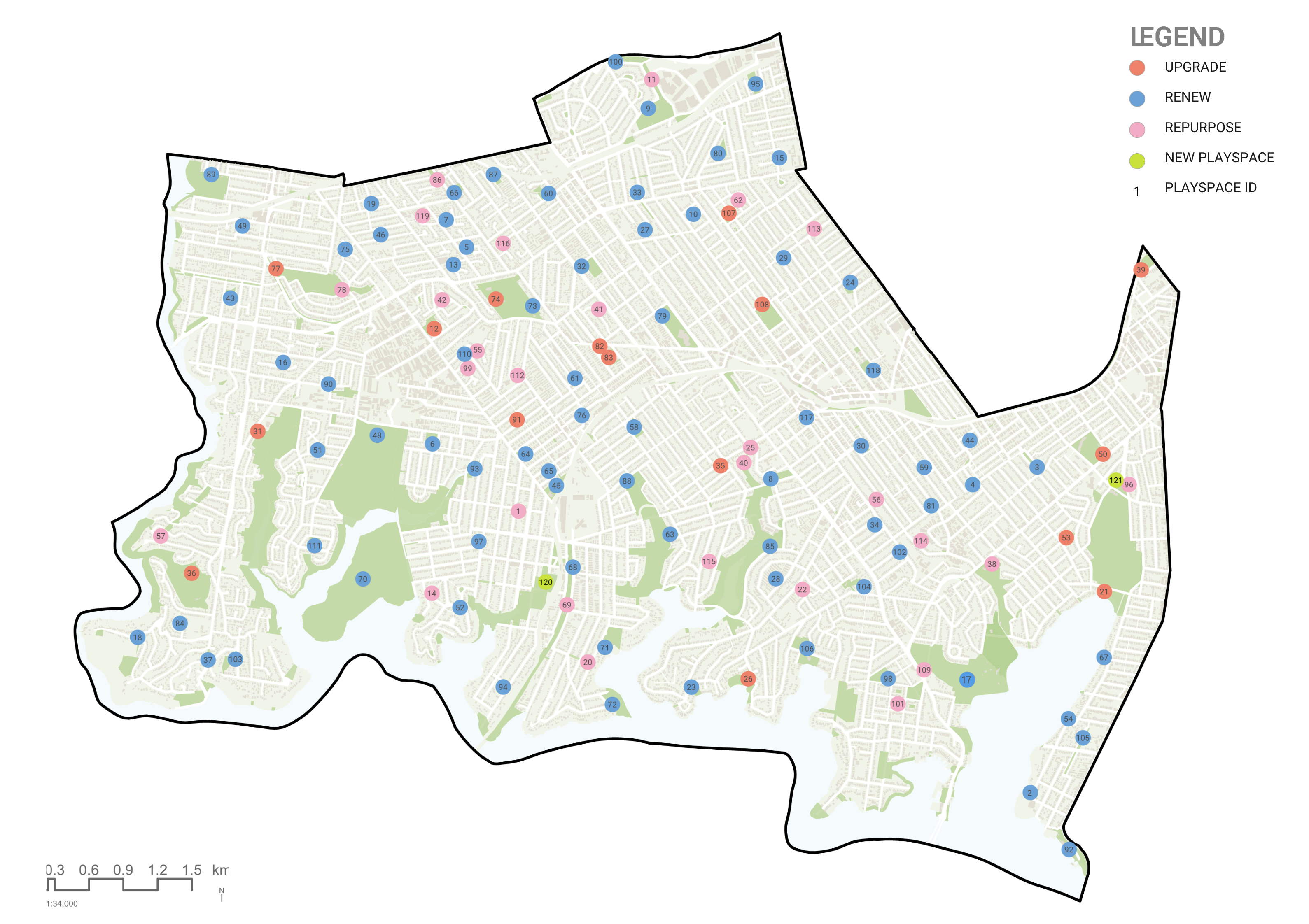
Upgrade: New equipment or features that increase the scale, range, accessibility or overall play experience. An upgrade may changes a local playspace to a neighbourhood playspace.
Renewal: Ageing equipment is replaced with a contemporary equivalent and the playspace is updated to meet current requirements. Its place in the level remains unchanged.
Repurpose: A playspace is changed to another public recreation or open-space use that is intended to respond to the needs of the surrounding area and wider network.
New playspace: In addition to existing playspaces, the Strategy proposes two new playspaces.
How is the network proposed to change?
Over the next 20 years, the Strategy proposes:
- 2 new playspaces
- 14 playspace upgrades
- 74 playspace renewals
- 30 existing playspace sites repurposed for alternative public open-space or recreation uses
This would result in a future network of 90 playspaces by 2046. Implementation would be staged rather than occurring all at once.
Why are some sites proposed for repurposing?
The draft Strategy identifies 30 sites where play equipment is nearing the end of its useful life and where another public open space or recreation use may better suit the site and wider network.
Possible future uses may include trees and shade, grassed areas, seating, walking or cycling links, informal recreation, or environmental improvements.
Repurposing would not remove the land from the public open space network. You can read more about repurposed sites in our FAQ.
How was the draft Strategy developed?
The work included a review of policies and play guidelines, site visits to all 118 playspaces, mapping, population analysis and community engagement.
The Strategy considered:
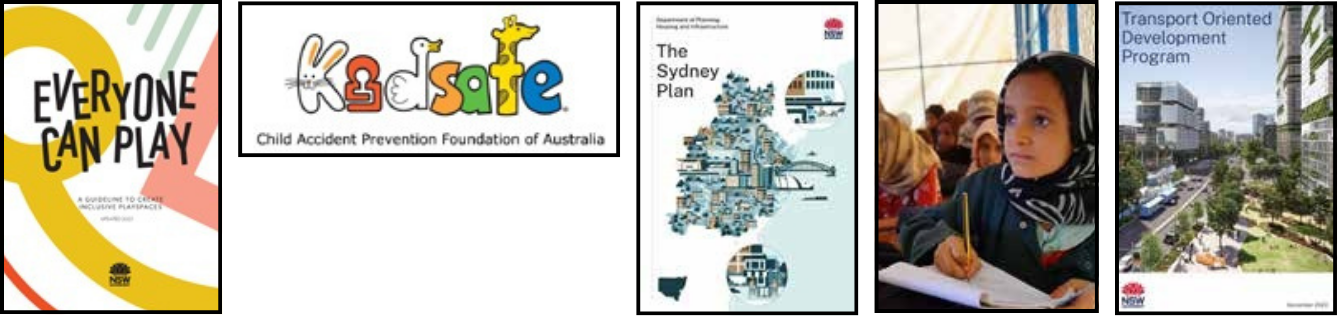
- NSW Government Everyone Can Play guidance
- Kidsafe NSW guidance
- The draft Sydney Plan
- The United Nations Convention on the Rights of the Child
- NSW planning reforms, including Transport Oriented Development and Low and Mid-Rise Housing policies
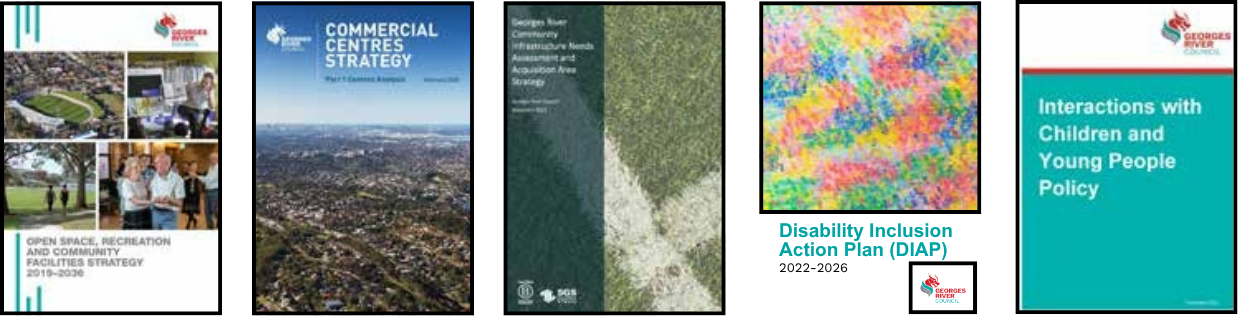
The Strategy also considered Council’s broader planning framework, including:
- Georges River 2025-2035 Community Strategic Plan
- Disability Inclusion Action Plan
- Community Infrastructure Needs Assessment and Acquisition Area Strategy
- Relevant asset, recreation and open-space planning
Between December 2025 and February 2026, the community told Council that key priorities included:
- More shade and seating
- Better access and maintenance
- More inclusive and varied play
- Facilities for a wider range of ages and abilities
What is being asked now?
The draft Playspace Strategy 2026-2046 is now on public exhibition from 7 October until 27 November 2026. We are seeking feedback on the whole draft Strategy, including its vision, principles, approach to play and design, and the order of future work, upgrades, renewals and repurposing.
On this page you can:
- View the draft Playspace Strategy 2026-2046
- Read frequently asked questions
- Provide feedback via our online form.
Hard copy versions are also available at:
- Georges River Civic Centre, corner of MacMahon and Dora Streets, Hurstville
- Clive James Library and Service Centre, Kogarah Town Square, Belgrave St, Kogarah
If you are returning a submission by email, mail or in person, please quote SF26/6652 Submission: draft Playspace Strategy 2026-2046.
Phone and email support
For help with the draft Playspace Strategy public exhibition, contact Council using the details below.
Phone: (02) 9330 6400
Email: mail@georgesriver.nsw.gov.au
Post: PO Box 205, Hurstville BC NSW 1481
What happens after public exhibition?
Language assistance
For a free interpreter call us via the Translating and Interpreting Service (TIS) on 131 450
If you have a hearing or speech impairment, please contact the National Relay Service:
- Voice Relay number: 1300 555 727
- TTY number: 133 677
-
Call us via the Translating and Interpreting Service (TIS):

Phone 131 450 -
Please contact the National Relay Service:

Phone 1300 555 727
