
Draft Blakehurst and Kogarah Bay Wards Flood Study
Council has adopted the draft Blakehurst and Kogarah Bay Wards Overland Flow Flood Study. Thank you to everyone who reviewed the study and provided feedback during the exhibition period. The final study will be published on our website shortly.
You can also read the full report and view the Council meeting by viewing our business papers or watching the recording of the April Council Meeting.
The next step will be to prepare a Floodplain Risk Management Study and Plan for the Blakehurst and Kogarah Bay Wards catchment. More information on this can be found under What are the next steps in the process? on this page.
About the draft flood study
The draft flood study looked at current and future flood risks to properties.
Heavy rainfall can sometimes overwhelm our stormwater drains, causing water to flow across roads and properties. This is called overland flooding and is different from riverine (or mainstream) flooding.
Stormwater drainage in this catchment consists of pits, pipes, and open channels which are designed to manage flows during smaller, more regular storms. However, the system is not intended to capture all surface runoff in larger storm events. Obstructions in overland flow paths can worsen this type of flooding across the catchment.
The draft study focusses predominantly on modelling overland flooding. Flood modelling for the draft study also takes into account other types of flooding, such as:
- Tidal or oceanic flooding: Low-lying coastal areas may flood during high tides or storm surges, which can push water back through drains and cause localised inundation.
- Mainstream flooding: Prolonged or intense rain can cause creeks, rivers, or lakes to overflow their banks.
The draft Flood Study has been undertaken in accordance with the relevant legislation, guidelines and best practice. The flood study was carried out by Kellogg Brown & Root (KBR).
You can read the full draft flood study here: Blakehurst and Kogarah Bay Wards Overland Flow Flood Study.
Council is now in the process of finalising this draft study, and will provide the final flood study once it is adopted by Council.
How we completed the draft flood study
To develop the study, KBR created a flood model using TUFLOW software to simulate flood behaviour across the whole area in the former Kogarah Local Government Area (LGA). TUFLOW is the industry standard software that creates detailed flood models to simulate how water behaves during heavy rainfall events.
As part of the draft flood study, we conducted community consultation in 2023:
We received 746 responses from residents and community members | |
Community feedback focused on past flood events in April 2015, March 2022, and February 2023 | |
Local sporting and community groups as well as the State Emergency Service (SES) also provided input |
To ensure accuracy, the model was tested and refined using real flood information provided by the community. The model was adjusted until its simulated flood levels closely aligned with historical observations. This validation process aimed to build confidence in the model before applying it to future flood predictions.
Why we did this draft flood study
We completed this draft flood study because the NSW Government requires all councils to:
| Regularly check flood risks | |
| Identify flood-prone areas | |
| Share this information with residents through planning certificates and flood maps | |
| Identify appropriate floodplain risk mitigation options to reduce existing flood risk |
The flood study helps us make better decisions about future development, ensure new buildings are built safely, find where we need better drainage, and give emergency services like the SES accurate flood information.
It also helps us understand nature and extent of catchment overland flooding. This type of flooding is generated by rain events where drainage systems quickly reach capacity and excess rainfall flows overland.
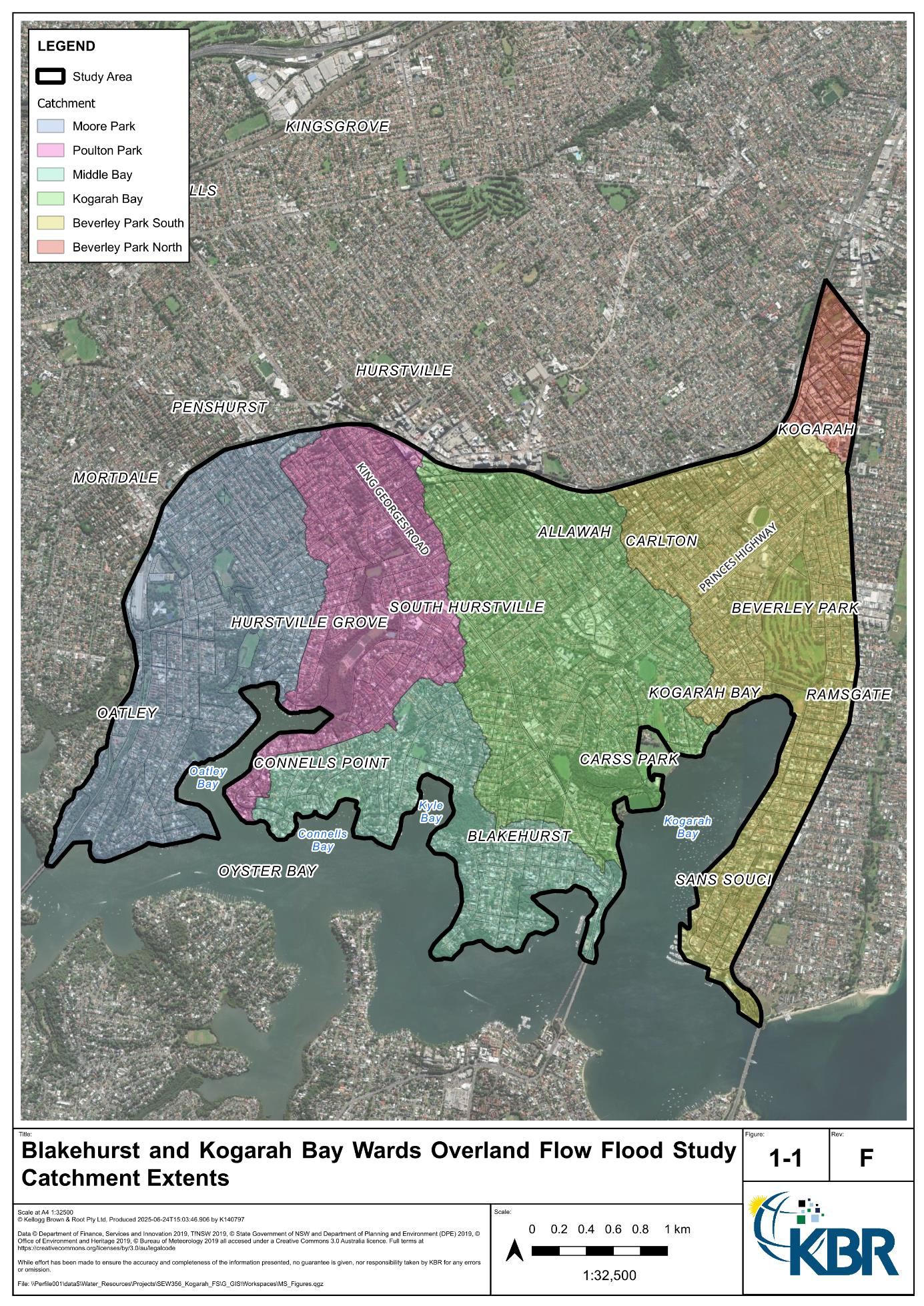
The draft flood study covers these suburbs:
| Allawah | Blakehurst | Beverly Park |
| Carlton | Carss Park | Connells Point |
| Hurstville (part) | Hurstville Grove | Kogarah |
| Kogarah Bay | Kyle Bay | Mortdale (part) |
| Oatley (part) | Penshurst (part) | Ramsgate (part) |
| Sans Souci (part) | South Hurstville |
Key findings from the flood study
Our flood experts created detailed computer models using the latest technology. The flood study looked at:
What happens during different sized rainfall events - from common storms to extremely rare ones | |
Which properties might be affected - and at what flood depth | |
How climate change might affect future flooding | |
Where flood waters flow - and how fast they move | |
What happens if drains get blocked - during heavy rain | |
This flood study doesn't create new flooding. It helps us understand flooding that already exists but may not have been mapped before. |
You can read the full draft flood study here: Blakehurst and Kogarah Bay Wards Overland Flow Flood Study
Understanding 1% AEP in the Blakehurst and Kogarah Bay Ward draft flood study
If your property is identified in the flood study:
This does not prevent you from redeveloping your property. However, if you do plan to redevelop, certain flood-related planning controls may apply. For example, you may need to build new structures above a set flood level to reduce the risk of damage.
If your property is identified in Council's flood study, it will include a notation that flood-related development controls apply to your land once the flood study is finalised and approved by Council.
This notation will be made on your property's Section 10.7 Planning Certificate, which is a legal document that shows what development is allowed on your property. Section 10.7 Planning Certificates are issued under Section 10.7 of the Environmental Planning and Assessment Act 1979.
For your day-to-day life: | |
Nothing changes with how you use your property now | |
Your rates will not increase because of this flood study | |
You can still maintain, repair, and renovate your home | |
For future development: | |
You can still develop your site with flood safe design | |
You can still maintain, repair, and renovate your home | |
If your property is not identified:
No flood-related development controls apply | |
Your Section 10.7 Planning Certificate will not show flood notations |
How to view the draft flood study, maps, and information
📌 Online mapping tool
Please note that the online map is based on the draft flood study and may be updated with revised information once the study is finalised.
Step 1: Visit Council's flood mapping website: Intramaps Overland Flow Flood Study Online Map
Step 2: Type your address in the search box or select your property by clicking/tapping on it
Step 3: Check if your property has been tagged:
- Light blue hatched areas: Probable Maximum Flood (PMF) - very rare, extreme flooding
- Dark blue hatched areas: 1% AEP flood - rare flooding (1 in 100 chance each year) and PMF
- No hatching: no flood risk identified
Step 4: View flood information such as depth, velocity and hazard using the layers panel
📄 View and download the full report |
| You can download and read the full draft report here: Blakehurst and Kogarah Bay Wards Overland Flow Flood Study |
📌Access our hard copy maps
You can still view and download a collection of maps of the local area, annotated with flood study information. Please note that these maps are based on the draft flood study and may be updated with revised information once the study is finalised. You can view and download the following maps:
- Flood Control Lot Tagging
- 1% Annual Exceedance Probability Future Climate Scenario - Peak Flood Depths
- 1% Annual Exceedance Probability Future Climate Scenario - Peak Flood Hazard
- Probable Maximum Flooding - Peak Flood Depths
- Probable Maximum Flooding - Peak Flood Hazard
Please note: these maps are large files (approximately 150MB)
What are the next steps in the process?
Subject to funding availability, we will prepare a Floodplain Risk Management Study and Plan for Blakehurst and Kogarah Bay Wards catchment.
The Floodplain Risk Management Study will evaluate flood risk management options for the floodplain in respect of both existing and future development. This will include the assessment of various:
- flood modification measures such as detention basins, levees, trunk drainage upgrades and channel improvements
- property modification measures such as the development of a set of prescriptive flood related development controls which would apply to future development located on flood liable land
- response modification measures such as improvements to flood emergency planning and weather warning systems, and the implementation of a flood awareness and education program.
The Floodplain Risk Management Plan will set out a preferred set of measures aimed at managing the flood risk. Once adopted, we will be able to seek funding from the NSW Government for its implementation.
While a date has not been set to start work on the Floodplain Risk Management Study and Plan, preparation would typically take between 18 months to 24 months.
We will seek early input from the local community on the range of potential measures which could form part of the draft Floodplain Risk Management Plan and the full document will be exhibited for comment prior to it being recommended to Council for adoption.
Do you need assistance reading and accessing this page?
For a free interpreter call us via the Translating and Interpreting Service (TIS) on 131 450
If you have a hearing or speech impairment, please contact the National Relay Service:
- Voice Relay number: 1300 555 727
- TTY number: 133 677
-
Call us via the Translating and Interpreting Service (TIS):

Phone 131 450 -
Please contact the National Relay Service:

Phone 1300 555 727

-
 1 Percent Annual Exceedance Probability Future Climate Scenario Peak Flood Depths (146 MB) (pdf)
-
1 Percent Annual Exceedance Probability Future Climate Scenario Peak Flood Hazard (143 MB) (pdf)
-
Flood Control Lot Tagging.pdf (137 MB) (pdf)
-
Probable Maximum Flooding - Peak Flood Depths.pdf (157 MB) (pdf)
-
Probable Maximum Flooding - Peak Flood Hazard.pdf (155 MB) (pdf)